Orchestration - Comparative analysis of 3 major open source platforms: Prefect, Kestra and Dagster
2026-07-16
Le paysage de l'orchestration des données, de l'intelligence artificielle (IA) et de l'infrastructure est en pleine mutation, exigeant des outils toujours plus résilients et flexibles. Cet article propose une analyse comparative de trois plateformes open source majeures : Prefect, Kestra et Dagster.
Une actualité récente vient d'ailleurs bouleverser cet écosystème : Prefect a officiellement annoncé l'acquisition de Dagster, marquant un tournant décisif dans le secteur de l'orchestration.
Voici un aperçu détaillé des caractéristiques, différences, avantages et inconvénients de chacune de ces solutions.
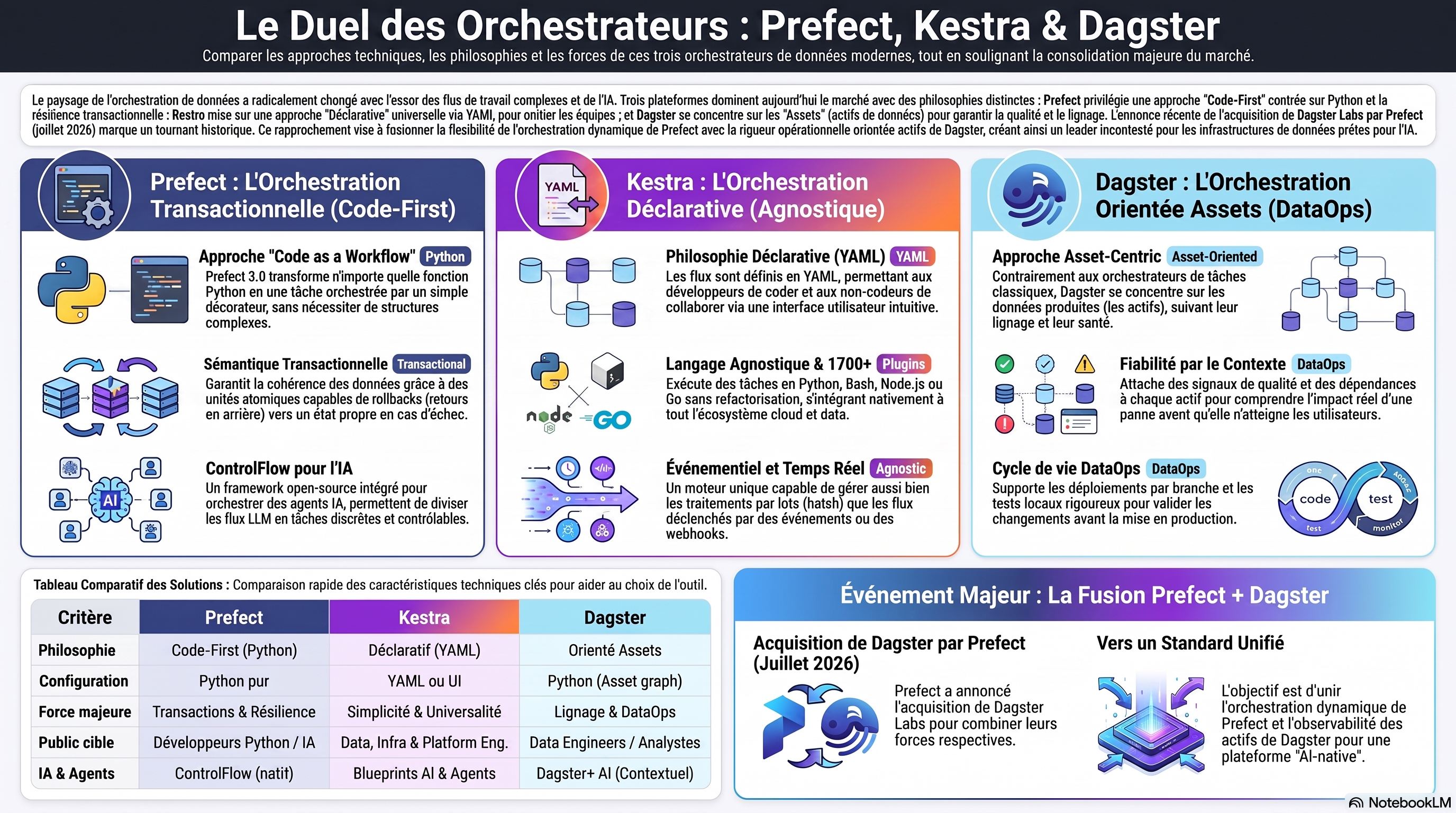
Prefect: Python Orchestration Par Excellence and Resilience by Design
Prefect's recent version 3.0 focuses on creating "resilient by design" workflows through a Python code-based approach. Prefect is particularly aimed at engineers who want to dynamically manage technological hazards and process failures.
Advantages
- Transactional Semantics: Prefect 3.0 allows grouping tasks into atomic units with the ability to restore state (rollback) in case of error. Workflows are idempotent by default, ensuring data integrity during pipeline retries.
- Ultra-portable and Lightweight: Its redesigned engine allows any Python function to be executed anywhere (local computer, cloud, serverless infrastructure) with up to a 90% reduction in execution overhead.
- AI-Ready with ControlFlow: Prefect includes ControlFlow, an open-source framework for orchestrating AI agents, allowing their actions to be controlled to prevent hallucinations and manage failures as with classical data.
Disadvantages
- Being intrinsically linked to Python code, it requires programming skills and may be less accessible to non-developer profiles or those working in ecosystems exclusively using other languages.
Kestra: Declarative and Cross-functional Orchestration for the Entire Enterprise
Unlike imperative code-based approaches, Kestra is a declarative, event-driven platform designed to unify workflows for data engineers, software engineers, and infrastructure.
Advantages
- Language Agnostic: With Kestra, you can use Python, Bash, Node.js, Go, or containers, which avoids any technological lock-in.
- Massive Plugin Ecosystem: The platform offers over 1700 plugins (Cloud, databases, CI/CD, AI tools, etc.), greatly limiting the need to write complex integration scripts.
- YAML Accessibility and UI Interface: Workflows are simply written in YAML. This approach allows all team members to collaborate seamlessly from a unified user interface or from code.
- Hybrid Orchestration: It manages both the triggering of infrastructure automations (Terraform, Ansible) and data or AI pipelines.
Disadvantages
- Writing complex workflows in YAML format can sometimes seem tedious for pure developers who prefer the expressiveness and infinite conditional logic offered by a standard programming language.
Dagster: The "Data Assets" Oriented Approach
Dagster defines itself as a native "DataOps" platform for AI, fundamentally distinguishing itself from the competition by its worldview. Where most classic orchestrators plan "tasks," Dagster observes and plans "assets" (the tables, models, or generated files).
Advantages
- Native Lineage and Quality Tracking: Each produced asset has its dependency context, lineage, and quality indicators attached to it.
- Error Anticipation (Blast Radius): In the event of a pipeline failure, Dagster instantly indicates what is broken and, more importantly, the cascading impact on downstream data even before the error propagates to stakeholders.
- Deep Integrations: Dagster offers native and first-class connections for tools widely used by data teams such as dbt, Snowflake, and Fivetran, without having to code custom connectors.
Disadvantages
- Primarily focused on data flows (DataOps), Dagster is less designed to globally orchestrate other areas of the IS (such as global IT infrastructure automation) compared to a solution like Kestra.
Summary of Key Differences
- Core Paradigm: Prefect focuses on transforming Python code into robust flows. Kestra uses a Declarative (YAML) approach. Dagster uses an asset-centric paradigm.
- Primary Target: Prefect is the tool for Python developers. Kestra addresses the entire enterprise (infrastructure, data, and AI engineers) thanks to its accessibility. Dagster specifically excels with data engineering teams looking to secure and trace pure data.
Note on the future: The announced acquisition of Dagster by Prefect will most certainly eventually unite the strengths of Prefect's ultra-resilient Python code with Dagster's "asset-centric" approach, a major point to watch for your architecture choice.*